Computer System Architecture - Central Processing Unit

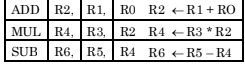
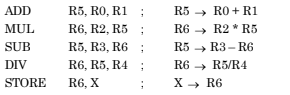
A pipelined processor uses a 4-stage instruction pipeline with the following stages : Instruction fetch (IF), Instruction decode (ID), Executive (EX) and Writeback (WB). The arithmetic operations as well as the load and store operations are carried out in the EX stage. The sequence of instructions corresponding to the statement X = (S – R* (P + Q))/T is given below. The values of variables P, Q, R, S and T are available in the registers R0, R1, R2, R3 and R4 respectively, before the execution of the instruction sequence.

central-processing

16. The number of Read-After-Write (RAW) dependencies, Write-After-Read (WAR) dependencies, and Write-After-Write (WAW) dependencies in the sequence of instructions are, respectively

  • Option : C
  • Explanation : Read After Write:
    1. ADD ⇾ MUL (because of R5)
    2. MUL ⇾ SUB (because of R6)
    3. SUB ⇾ DIV (because of R5)
    4. DIV ⇾ STORE (because of R6)
    Write After Read
    1. MUL ⇾ SUB (because of R5)
    2. DIV ⇾ STORE (because of R6)
    Write After Write
    1. ADD ⇾ SUB (because of R5)
    2. MUL – DIV (because of R6)
Cancel reply
Cancel reply

A pipelined processor uses a 4-stage instruction pipeline with the following stages : Instruction fetch (IF), Instruction decode (ID), Executive (EX) and Writeback (WB). The arithmetic operations as well as the load and store operations are carried out in the EX stage. The sequence of instructions corresponding to the statement X = (S – R* (P + Q))/T is given below. The values of variables P, Q, R, S and T are available in the registers R0, R1, R2, R3 and R4 respectively, before the execution of the instruction sequence.

central-processing

Consider the following program segment. Here R1, R2 and R3 are the general purpose registers.
Assume that the content of memory location 3000 is 10 and the content of the register R3 is 2000. The content of each of the memory locations from 2000 to 2010 is 100. The program is loaded from the memory location 1000. All the numbers are in decimal.

20. Assume that the memory is word addressable. The number of memory references for accessing the data in executing the program completely is

  • Option : D
  • Explanation : Ist memory reference R1 ⇽ M[3000] and then in the loop which runs for 10 times, because the content of memory location 3000 is 10 given in question and loop will run 10 times as
    {
    R2 ⇽ M[R3]
    M[R3] ⇽ R2
    }
    So Two memory reference every iteration
    10 * 2 = 20
    Total = 20 + 1 = 21
Cancel reply
Cancel reply