


Monitor and Printer is an output devices
whereas Joystick, Keyboard, Mouse and
Digitiser are input devices.
UGC NET Paper1 Previous Year Solved Papers MCQ - 5th December 2019 Evening Shift
The high global warming potential (GWP) greenhouse gases include hydro fluorocarbons (HFCs), per fluorocarbons
(PFCs) and sulphur hexafluoride (SF6). Like other GHGs, these gases trap heat in the atmosphere, but they are hundreds
to thousands of times more effective
at trapping heat, which leads to greater
warming of the planet, compared to carbon
dioxide (CO2). The primary greenhouse
gases in the atmosphere are water vapor,
carbon dioxide, methane, nitrous oxide,
and ozone. Water vapour accounts the
largest greenhouse effect (90-85%).
The CFCs, hydro fluorocarbons (HFCs),
hydro chlorofluorocarbons (HCFCs),
per fluorocarbons (PFCs), and sulphur
hexafluoride (SF6) are referred to as high GWP
gases, that is, GWP can be up to tens
of thousands. For a given amount of mass, they hold substantially more heat than does CO2.
Forests improve air quality by absorbing carbon dioxide which traps much more heat
from the sun than is required, leading to global warming. So, Assertion (A) is true.
Breathing ozone can trigger a variety of
health problems including chest pain,
coughing, throat irritation, and airway
inflammation. It also can reduce lung
function and harm lung tissue. Tropospheric
ozone is a highly reactive oxidant that
significantly reduces crop productivity as
well as the uptake of atmospheric carbon
by vegetation. It impedes plant growth and
seed production, reduces functional leaf
area and accelerates ageing. So, Reason
(R) is true but does not explain (A).
24
Which one of the following factors is a deterrent
for the students to do well in higher education?
Institutions of Higher Education usually
have students' council to represent students
before the administration. However, these
unions invariably have political orientation;
they function more or less as the trainee
units of those political parties and cannot
avoid their interference. All this acts as a
deterrent for the students to do well.
Let income of z is P
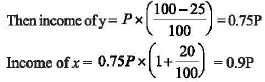 Ratio of incomes of X : Y and Z
= 0.9 : 0.75 : 1
= 18 : 15 : 20
Ratio of incomes of X : Y and Z
= 0.9 : 0.75 : 1
= 18 : 15 : 20
Ratio of incomes of X : Y and Z
= 0.9 : 0.75 : 1
= 18 : 15 : 20