
Corporate restructuring can be defined as any change in the business capacity or portfolio that is carried out by an inorganic route or a change in the capital structure of a company
that is not a part of its ordinary course of business or any change in the ownership of or control over the management of the company or a combination thereof.
UGC NET Management Previous Year Solved Papers MCQ - December 2019
47
Match the following constructs of asset pricing with its propagators.
Choose the correct match from options given below:
| Asset Pricing Constructs | Proposer(s) |
| (a) Mean-Variance portfolio criterion | (i) Black and Scholes |
| Size and Book to market value portfolios | (ii) Sharpe, Lintner, and Mossin |
| (c) The capital Asset Pricing model | (iii) Fama & French |
| (d) Derivative (option) pricing | (iv) Markowitz, Harry |
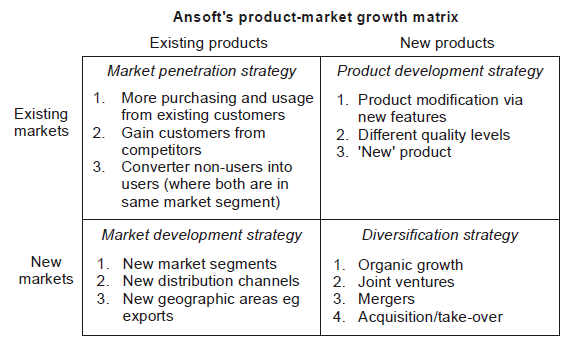
Ansoff’s product-market growth matrix presents four options. Staying with your existing product in your existing market is low risk, however moving into a new market with an existing product increases the risks, as does a new product in an existing market. The greatest risk is with a new market and product.
50
Which of the following sequence are the steps of ‘QUEST’ technique of external economic analysis?
- A Conceptualization Phase → Evaluation Phase → Feedback Phase → Analysis Phase


- B Preparation Phase → Divergent Planning Phase → Option Identification Phase → Scenario Development Phase<
- C Development Phase → Scanning Phase → Evaluation Phase → Strategic Implementation Phase
- D Scanning Phase → Segmentation Phase → Generative Phase → Review Phase
QUEST may be defined as a futures research process designed to permit executives and planners in an organization to share their views about trends and events in future
external environments that have critical implications for the organization’s strategies and policies. It is a systematic, intensive, and relatively inexpensive way to develop a
shared understanding of high priority issues and to focus management’s attention quickly on strategic areas for which more detailed planning and analysis would be beneficial.
The basic assumption of the QUEST technique is that each member of the top management team of a corporation already has a view of the dynamics of the changing environment of the organization. In the aggregate, these assumptions represent the organization’s understanding of its environment. Although extremely important for strategic planning, this understanding is rarely articulated and shared. In some cases, these collective views of the environment may be fairly accurate since each manager is in touch with a variety of constituencies and brings years of experience to bear upon the interpretation of the significance of external events for the organization. However, this may not necessarily be the case, as conventional wisdom may limit perceptions of change. Thus, it becomes important to spell out assumptions about the environment in a systematic framework so that they can be aggregated, examined, tested, and put to use for strategic purposes.
The basic assumption of the QUEST technique is that each member of the top management team of a corporation already has a view of the dynamics of the changing environment of the organization. In the aggregate, these assumptions represent the organization’s understanding of its environment. Although extremely important for strategic planning, this understanding is rarely articulated and shared. In some cases, these collective views of the environment may be fairly accurate since each manager is in touch with a variety of constituencies and brings years of experience to bear upon the interpretation of the significance of external events for the organization. However, this may not necessarily be the case, as conventional wisdom may limit perceptions of change. Thus, it becomes important to spell out assumptions about the environment in a systematic framework so that they can be aggregated, examined, tested, and put to use for strategic purposes.
