


(a) {wwR |w ∈ {a, b}* } is a CFL
(b) {wan bn wR |w ∈ {a, b}*, n ≥ 0} is a CFL, since we can first push w, then a’s, b’s pop with a’s and wR pops with the w. So PDA can accept the language.
(c) {wanwR bn|w ∈ {a, b}*, n ≥ 0} is a not CFL because after pushing w, we need to push a’s into stack which will stop the w from being matched with wR. If we don’t push a’s after w, than later we cannot match with bn. So this language is not acceptable by a PDA and hence not a CFL.
(d) {anbi |i ∈ {n, 3n, 5n}, n ≥ 0}
= anbn∪ anb3n∪ anb5n is CFL since each of the three parts is a CFL and closure under union guarantees that result also is a CFL.
PREVIOUS YEAR SOLVED PAPERS MCQ - GATE 2019
X(PQRS) {QR → S, R → P, S → Q} decomposed into
The common attribute between Y and Z relations is R which is key for relation Y.
So that given decomposition is lossless join decomposition.
R → P in Y
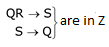 and dependency preserving decomposition.
Hence, C is the correct answer.
| Y(PR) | Z(QRS) |
| {R → P} | {QR → S, S → Q} |
| Candidate key : R | Candidate key : QR, RS |
| Relation Y in BCNF | Relation Z in 3NF but not BCNF |
and dependency preserving decomposition.
Hence, C is the correct answer.1 word = 4 bytes
Page size = 8 kB = 213 B
Number of words in 1 page = 213/22 = 211
TLB can hold 128 valid entries so, at most 128 × 211 memory address can be addressed without TLB miss.
128 × 211 = 256 × 210
S1: The set : LRE is known to be countably infinite since it corresponds with set of turing
machines.
S2: Since syntactically valid C programs surely run on Turing machines, this set is also :
a subset of set of Turing machines, which is countable.
S3: Set of all languages = 2Σ which is known to be uncountable. Σ* countably infinite
⇒ 2Σ is uncountable.
S4: Set of all non-regular languages includes set : L NOT RE which is uncountable infinite
and hence is uncountable.
So, S3 and S4 are uncountable.
∀x[∀z⊗x ⇒ ((z = x) ∨ (z = 1)) ⇒ ∃w (w > x) ∧ (∀z z⊗w ⇒ ((w = z) ∨ (z = 1)))]
The predicate ϕ simply says that if z is a prime number in the set then there exists another prime number is the set which is larger.
Clearly ϕ is true in S2 and S3 since in set of all integers as well as all positive integers, there is a prime number greater than any given prime number.
However, in S1 : {1, 2, 3, .....100} ϕ is false since for prime number 97 ∈ S1 there exists no prime number in the set which is greater.
So correct answer is C.
