


According to chinese remainder theorem:
= 351 mod 5
= (33)17 mod 5
= (27)17 mod 5
= {(22)8*21} mod 5
= {(4)8*(2)} mod 5
= {(-1)8*(2)} mod 5
= {(1*2)} mod 5
= {(2)} mod 5
= 2
PREVIOUS YEAR SOLVED PAPERS MCQ - GATE 2019
The 4-bit binary representation of numbers (1, 2, 3, 4………13):
0 - 0000
1 - 0001
2 - 0010
3 - 0011
4 - 0100
5 - 0101
6 - 0110
7 - 0111
8 - 1000
9 - 1001
10 - 1010
11 - 1011
12 - 1100
13 - 1101
There 6 numbers which start with MSB as 1, and 7 numbers which start with MSB as 0.
Therefore, probability that their 4-bit binary representations have the same most significant bit is,
= P(MSB is 0) + P(MSB is 1)
= (7×7)/(13×13) + (6×6)/(13×13)
= (49+36)/169
= 85/169
= 0.5029
Option (A) is correct.
Minimum value (X) of D will possible when,
P2 reads D=100, preempted.
P1 executes D=D+20, D=120.
P3 executes D=D+10, D=130.
Now, P2 has D=100, executes, D = D-50 = 100-50 = 50. P2 writes D=50 final value.
So, minimum value (X) of D is 50.
Maximum value (Y) of D will possible when,
P1 reads D=100, preempted.
P2 reads D=100, executes, D = D-50 = 100-50 = 50.
Now, P1 executes, D = D+20 = 100+20 = 120.
And now, P3 reads D=120, executes D=D+10, D=130. P3 writes D=130 final value.
So, maximum value (Y) of D is 130.
Therefore,
= Y - X
= 130 - 50
= 80
So, option (A) is correct.
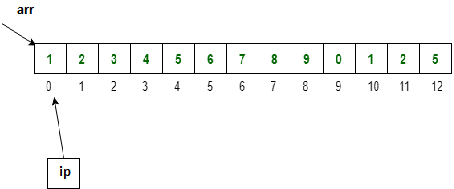 Initially ip pointer is pointing at (arr+4) or skipping starting first 4 position.
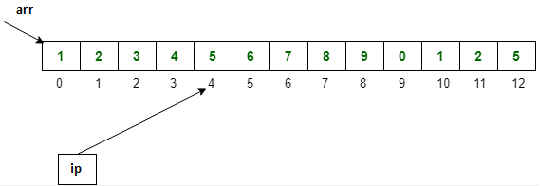 Now in the printf system call, 1 more position is to skip, So it will point to (arr+5) or skip 5 position from starting:
Hence, printf will print value at 6th position, i.e., 6 will printed.
So, option (A) is correct.
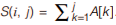 . Determine the maximum of S(i, j), where 0 ≤ i ≤ j < Divide and conquer approach may be used.)
According to largest Sum Contiguous subarray is from index 2 to 11,
Max (S(i, j))
= S(2, 11)
= 6 + 3 + (-1) + (-2) + 13 + 4 + (-9) + (-1) + 4 + 12
= 29
So, answer is 29.
