Statistics - Probabilities

Avatto > > ACET > > PRACTICE QUESTIONS > > Statistics > > Probabilities

16. Let Let A and B be two events defined as

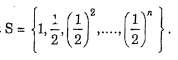
Let A and B be two events defined as
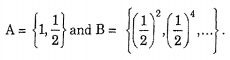
Let A and B be two events defined as

Then P (A ∩ B) will be

  • Option : A
  • Explanation : A ∩ B = φ

    P (A ∩ B) = 0

Cancel reply

Your email address will not be published. Required fields are marked *


Cancel reply

Your email address will not be published. Required fields are marked *


17. If E1 ,  E2 .... , En are n mutually exclusive event, then the probability of the happening of any one of them is equal to the sum of the probabilities of the happening of separate events.

i.e.,  P(E1 ∪ E2 ∪ E3 .... ∪ En

       = P(E1) +  P(E2) +....  + P(En)

This is

Cancel reply

Your email address will not be published. Required fields are marked *


Cancel reply

Your email address will not be published. Required fields are marked *


18. What is the probability of correctly choosing an unknown integer between 0 to 9 within three chances?

  • Option : B
  • Explanation : S = [0, 1, 2, ....,9)
    Suppose we want a particular integer "3" to be
    chosen.
    9
    Probability of not choosing "3" is 9/10 (in one
    chance)
    Probability of not choosing 3 in all the three
    chances
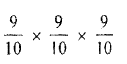
                         Probability

    Hence probability of choosing it in at least one
    of the three chances
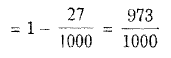
                Probability

Cancel reply

Your email address will not be published. Required fields are marked *


Cancel reply

Your email address will not be published. Required fields are marked *


19. A five figure number is formed by the digits 0, 1,2,3,4 without repetition. Then the probability that the number formed is divisible by 4 is

  • Option : B
  • Explanation : The five digits can be arranged in 5! ways, out
    of which 4! will begin with zero.

    Total number of 5-figure numbers formed
                         = 5! - 4! = 96.
    Those numbers formed will be divisible by 4
    which will have two extreme right digits
    divisible by 4,
    i.e., numbers ending in 04, 12,20,24,32,40.
    Now, numbers ending in 04 = 3! = 6,
    numbers ending in 12 = 3! - 2! = 4,
    numbers ending in 20 = 3! = 6,
    numbers ending in 24 = 3! - 2! = 4,
    numbers ending in 32 = 3! - 2! = 4,
    and numbers ending in 40 = 3! = 6.
    [Numbers having 12, 24, 32 in the extreme right
    are (3! - 2!), since the numbers having zero on
    t.he extreme left are to excluded.]
    Total number of favourable ways
    6 + 4 + 6 + 4 + 4 + 6 = 30
    Hence,    required probability = Probability

Cancel reply

Your email address will not be published. Required fields are marked *


Cancel reply

Your email address will not be published. Required fields are marked *


20. A bag contains 8 white and 6 red balls. The probability of drawing two balls of the same colour is

  • Option : B
  • Explanation : Two balls out 14 can be drawn in 14C2 ways which is the total number of outcomes.

    Two white balls out of 8 can he drawn in 8C2 ways

    Probability of drawing 2 white balls
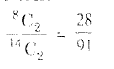
                                                              Probability

    Similarly 2 red balls out of 6 call be drawn in
    6C2 ways
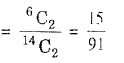
                                                                Probability
    Probability of drawing 2 red balls
    Probability of drawing 2 balls of the same
    colour (either both white or both red)
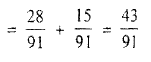
      Probability

Cancel reply

Your email address will not be published. Required fields are marked *


Cancel reply

Your email address will not be published. Required fields are marked *


Related Quiz.
Probabilities