
UGC NET Management Previous Year Solved Papers - December 2019
81. Novation, a feature of future exchanges stipulates:
- Option : B
- Explanation : Novation: Novation means that the exchange becomes a counter-party for all trades. Thus if A buys a futures contract from B, the exchange replaces this transaction with two transactions. In one transaction, the exchange buys from B and in another transaction, the exchange sells to A. The advantage of this process is that now neither A nor B needs to know anything about each other as legally
speaking, they are not dealing with each other at all. Even if A defaults, the exchange has to fulfill its obligation to B and try and sell the asset in the market at whatever price it can procure.
The credit risk is thus intermediated by the exchange, just as in many forward markets the credit risk is intermediated by banks. As the exchange relies on sophisticated margining systems to manage the credit risk, it does not have to charge a large fee to cover the risk.
82. Why has the bureaucratic form of organization been fundamentally questioned?
- A
The pressure of Globalization has rendered it unsuitable


- B
Organizations are experiencing acute pressure to change and pursue innovation as a means of securing business growth
- C
Organizations have grown so large that it is almost impossible to create an effective bureaucracy to manage them
- D
Information Technology has made it redundant
83. Customer Life Time Value (CLV) in the first year is
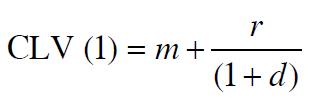
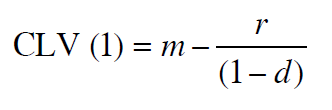
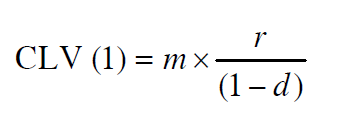
- Option : A
- Explanation : Customer Lifetime Value (CLV): When customers purchase products/services, the firm earns revenues; it also accrues costs. If sales revenues are greater than costs, the firm earns profits. The profit earned from an individual customer during a single time period (year) is the profit margin—the annual value the customer brings to the firm. Of course, many customers—consumers (B2C), partners, distributors, and resellers (B2B)—purchase the firm’s products for several successive years. Each year, the firm receives sales revenues, accrues costs, and earns a profit margin. CLV takes into account profit margins the firm earns in each of these years.
Some firm customers this year will not be customers next year. They may defect to competitors, or stop buying the types of products the firm offers. In calculating CLV, we must consider customer defection and customer retention. Retention rate is simply the number of retained customers at the end of the year, divided by the number of customers at the start of the year. If the firm starts the year with 100 customers and ends the year with 80 of these same customers, the retention rate is 80 percent. Retention is the inverse of defection (churn ). In this illustration, the defection rate is 20 percent (100 percent minus 80 percent). Understanding CLV allows the firm to better manage its customer base.
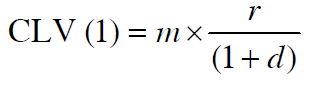
Calculating CLV: In each year, the firm earns a portion of its CLV. In the first year, it earns
CLV (1):
CLV (1) = m × r/(1 + d)
Restating this simple expression in words, CLV (1) is:
> The profit margin (m) the firm earns in year 1.
> Multiplied by the retention rate (r)—the probability that a customer at the start of the year will still be a customer at the end of the year.
> Discounted back to the start of the year, using the term 1/(1 + d). The discount rate (d) is the firm’s cost of capital– typically provided by the Chief Financial Officer ( CFO).
- Option : C
- Explanation : Composite leverage refers to combining both the operating leverage and financial leverage. Composite leverage discloses the effect on the income statem ent. In other words, operating and financial leverage combine themselves in a multiplicative form to bring about a more proportionate change in earning per share for a given percentage of change in activity. For both operating and financial leverage, one can determine the degree of leverage. In the first case, relate the change in profits that accompanies a change in output; secondly the change in earnings per share that accompanies a change in earnings before interest and taxes. Thus, both type of leverages explain the degree of business risk and financial risk.
- Option : B
- Explanation : Behavioural Segmentation
Behavioural segmentation dividing a market into subgroups (segments) of customers/users according to how they buy, use and feel about products.
The growth of out-of-town and edge-of-town supermarkets and shopping malls has changed shopping behaviour. As most shoppers travel by car, it has been possible to increase the size of bulk packaging of such items as soap powders as they only have to be transported to the car park. In contrast, social changes, such as the increasing numbers of working mothers and the growth in single households, have resulted in increased sales of pre-packaged meals for one that can be prepared quickly in the microwave.
Behavioural segmentation can be based on very different variables some of which are market-specific, some more generally applicable, for example, the chocolate market could be segmented into individual consumption, sharing and gift purchases— this would not be a good way to segment the market for medicines. Typical behavioural segmentation variables include:
loyalty status
frequency of purchase
rate of consumption
user status
attitudes towards the product
benefits sought
purchase occasion: what the customer is buying the product for—general use or a special occasion such as a party
