
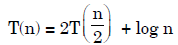


Since f(n) = log n
a = 2, b = 2
finding logba using master’s method = log22 = 1
Hence, f(n) = n'
So, T(n) = Θ(n)
Data Structures and Algorithms MCQ - Performance Analysis of Algorithms and Recurrences
The time complexity is O (m + logn)
So C = 1, d = 0, a = 0, b = 1
0 + 10 × 1 + 100 × 1 + 1000 × 0 = [110]
* Outer loop (for i) executed n times.
* Loop (for j) executed logn times so value of
p = logn.
loop (for k) executed log p times.
So value of q = log p = log logn.
for every value of i loop (k) is executed so return
value is n * log logn
Unsorted array
The algorithm perform
find operation (log N)½
Insert operation N
delete operation (log N)½
decrease key operations (log N)½
Hence unsorted array is best data structure for
all above operations.
The subtrees are already Max-heap, so to make
it half, we have to heap if the root, which takes
Ω(log n) time.
