Data Structures and Algorithms - Performance Analysis of Algorithms and Recurrences

Avatto > > UGC NET COMPUTER SCIENCE > > PRACTICE QUESTIONS > > Data Structures and Algorithms > > Performance Analysis of Algorithms and Recurrences

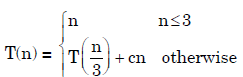
61. The running time of an algorithm is represented by the following recurrence relation:

 Which one of the following represents the time complexity of the algorithm?

  • Option : A
  • Explanation :
    Applying Master’s Theorem
    cn > nln3 1
    cn > n0
    Now checking af(n/b) ≤ kf(n) for some k < 1
    1*cm/3 ≤ kcn
    This is true for k > 1/3
    Hence solution is Θ(n).
Cancel reply

Your email address will not be published. Required fields are marked *


Cancel reply

Your email address will not be published. Required fields are marked *


62. Two alternative packages A and B are available for processing a database having 10k records. Package A requires 0.0001 n2 time units and package B requires 10nlog10n time units to process n records. What is the smallest value of k for which package B will be preferred over A?

  • Option : C
  • Explanation :
    B must be preferred on A as
    0.0001 n2 < 10 n log10 n
    ⇒ 10-5 n < log10n
    ⇒ 10-5 < log10n1/n
    ⇒ n 10-5 < log10n
    We know log10n = k
    ⇒ 10k = t
    ⇒ k > 10-5 10k
    ⇒ k > 10k-5
    ⇒ k – 5 > 0
    ⇒ k > 5
    Then min k = 6
Cancel reply

Your email address will not be published. Required fields are marked *


Cancel reply

Your email address will not be published. Required fields are marked *


63. Let W(n) and A(n) denote respectively, the worst case and average case running time of an algorithm executed on an input of size n. Which of the following is ALWAYS TRUE?

  • Option : C
  • Explanation :
    If B(n), XXA(n) and W(n) denote best case, average case and worst case time complexities of an algorithm P respectively then B(n) = O(A(n)), A(n) = O(W(n))
Cancel reply

Your email address will not be published. Required fields are marked *


Cancel reply

Your email address will not be published. Required fields are marked *


64. The recurrence relation capturing the optimal execution time of the Towers of Hanoi problem with n discs is

  • Option : D
  • Explanation :
    Let the three pegs be A,B and C, the goal is to move n pegs from A to C using peg B The following sequence of steps are executed recursively
    1. move n – 1 discs from A to B. This leaves disc n alone on peg A ..... T(n – 1)
    2. move disc n from A to C ..... 1
    3. move n – 1 discs from B to C so they sit on disc n T(n – 1)
    So, T(n) = 2T(n – 1) + 1
Cancel reply

Your email address will not be published. Required fields are marked *


Cancel reply

Your email address will not be published. Required fields are marked *


65. Consider the following function:

 {
  int i, j, k = 0;
  for (i = n/2; i < = n; i++)
   for(j = 2; j< = n; j = j*2)
    k = k + n/2;
 return (k);
 }
 The return value of the function is

  • Option : B
  • Explanation :
    Θ(n3)
    So, this is in Θ(log n)
    Hence Answer is (B)
    The outer for-loop goes for iterations. The inner for-loop runs independent of the otuer loop. And for each inner iteration n/2 gets added to k.
    ∴ Answer = n/2 x # outer loops x #Inner loops per outer loop
    # Inner loops = Θ(log n)       [∵2 Θ(log n) = Θ(n)]
    ∴ Answer =

Cancel reply

Your email address will not be published. Required fields are marked *


Cancel reply

Your email address will not be published. Required fields are marked *