PREVIOUS YEAR SOLVED PAPERS MCQ - June 2019

Correct AnswerOption C
Rate difficulty Rate difficulty:
Choose a difficulty.
Share this question
Share:
Giffen Paradox: The Positively Slopped Demand Curve: If the commodity in question is an inferior good, the increase in real income resulting from the reduction in its price will lead the consumer to purchase less, not more, of the commodity.
Thus, the income effect will be negative while the substitution effect continues to be positive to lead the consumer to purchase more of the commodity when its price falls. For most of the inferior goods, the positive substitution effect will be more than offset the negative income effect so that the demand curve is negatively sloped.
However, in the very rare case when the consumer spends so much on the inferior commodity that the strong negative income effect overwhelms the positive substitution effect the quantity demanded of the commodity will fall when its price falls and rise when its price rises.
In other words, the demand curve in this case will be positively sloped. The commodity in question is then called a Giffen goods, after the 19th century English economist Robert Giffen, who first discussed it. This is what is called Giffen Paradox that makes the demand curve to have a positive slope.
Cancel reply

Your email address will not be published. Required fields are marked *


Cancel reply

Your email address will not be published. Required fields are marked *

Correct AnswerOption A
Rate difficulty Rate difficulty:
Choose a difficulty.
Cancel reply

Your email address will not be published. Required fields are marked *


Cancel reply

Your email address will not be published. Required fields are marked *

Correct AnswerOption D
Rate difficulty Rate difficulty:
Choose a difficulty.
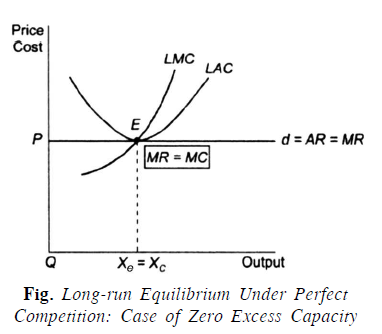
Excess capacity is a long-run concept. Excess capacity, broadly speaking, measures the difference between least cost output and the profit-maximizing output; least cost output corresponds to the minimum point on the LAC curve and the profit maximising output corresponds to that point where MR = MC.
Excess Capacity in Perfect Competition: In perfect competition, due to free entry and exit of firms, normal profit are earned in the long-run. There is no excess capacity as the firm earns normal profit and stays at the minimum point of LAC curve (Fig.) That is, the least cost output coincides with the profit maximising output i.e., Xc = Xe. It is shown in fig.
Perfect competition
Cancel reply

Your email address will not be published. Required fields are marked *


Cancel reply

Your email address will not be published. Required fields are marked *

Correct AnswerOption A
Rate difficulty Rate difficulty:
Choose a difficulty.
Cancel reply

Your email address will not be published. Required fields are marked *


Cancel reply

Your email address will not be published. Required fields are marked *

Correct AnswerOption C
Rate difficulty Rate difficulty:
Choose a difficulty.
Found this useful?
Follow:
Exemption under Section 54: When an individual sells a residential property and buys another residential property, he will be eligible for exemption under Section 54. Conditions to avail the benefit of exemption under Section 54 includes:
∎ The tax payer (i.e., seller) needs to be an individual or HUF. Thus, firms, LLP’s and companies cannot utilize the benefits of this section.
∎ Asset needs to be classified as a long-term capital asset.
∎ The asset sold is a Residential House. Income from such a house should be chargeable as Income from House Property.
∎ The seller should purchase a residential house either 1 year before the date of sale/ transfer or 2 years after the date of sale/ transfer. In case the seller is constructing a house, the seller has an extended time, i.e., the seller will have to construct the residential house within 3 years from the date of sale/transfer. In case of compulsory acquisition, the period of acquisition or construction will be determined from the date of receipt of compensation (whether original or additional compensation).
∎ The new residential house should be in India. The seller cannot buy or purchase a residential house abroad and claim the exemption.
The above conditions are cumulative. Hence, even if one condition is not fulfilled, then the seller cannot avail the benefit of the exemption under Section 54.
Cancel reply

Your email address will not be published. Required fields are marked *


Cancel reply

Your email address will not be published. Required fields are marked *

Why Practice with Avatto?
High Quality MCQsExam-focused questions with accurate answers
Detailed ExplanationsStep-by-step explanations to enhance learning
Latest Exam PatternBased on updated syllabus and pattern
Performance AnalyticsTrack performance and improve weak areas
100% Free PracticePractice unlimited questions for free