
PREVIOUS YEAR SOLVED PAPERS MCQ - June 2019


82
Match List-I with List-II:
Choose the correct code from those given below:
| List-I | List-II |
| (a) Fiscal, monetary and industrial policies | (i) Social responsibilities |
| (b) Social obligation towards several stakeholders | (ii) Stakeholders/interest group |
| (c) Consumers, shareholders, suppliers, creditors etc. | (iii) Business ethics |
| (d) Moral principles that defines the right or wrong policies | (iv) Economic |
Codes
| (a) | (b) | (c) | (d) | |
| 1 | (iii) | (i) | (iv) | (ii) |
| 2 | (i) | (ii) | (iv) | (iii) |
| 3 | (ii) | (iv) | (iii) | (i) |
| 4 | (iv) | (i) | (ii) | (iii) |
The concern of the financing decision is with
the financing-mix or capital structure or
leverage. The term capital structure refers to
the proportion of debt (fixed-interest sources
of financing) and equity capital (variable-dividend
securities/source of funds). The
financing decision of a firm relates to the
choice of the proportion of these sources to
finance the investment requirements. There
are two aspects of the financing decision.
First, the theory of capital structure which
shows the theoretical relationship between
the employment of debt and the return to the
shareholders. The use of debt implies a higher
return to the shareholders as also the financial
risk. A proper balance between debt and
equity to ensure a trade-off between risk and
return to the shareholders is necessary. A
capital structure with a reasonable proportion
of debt and equity capital is called the
optimum capital structure. Thus, one
dimension of the financing decision whether
there is an optimum capital structure and in
what proportion should funds be raised to
maximise the return to the shareholders? The
second aspect of the financing decision is
the determination of an appropriate capital
structure, given the facts of a particular case.
Thus, the financing decision covers two
interrelated aspects: (1) the capital structure
theory, and (2) the capital structure decision.
84
Match List-I with List-II:
Choose the correct code from those given below:
| List-I | List-II |
| (a) Sec 6(i) | (i) Agriculture Income |
| (b) Sec 10AA | (ii) Leave Travel Concession |
| (c) Sec 10(i) | (iii) Resident |
| (d) Sec 10(5) | (iv) Leave Salary |
Codes
| (a) | (b) | (c) | (d) | |
| 1 | (i) | (iv) | (iii) | (ii) |
| 2 | (iii) | (iv) | (ii) | (i) |
| 3 | (iii) | (ii) | (iv) | (i) |
| 4 | (iii) | (iv) | (i) | (ii) |
Major Channel Alternatives: Companies can choose from a wide variety of channels for reaching customers - from sales forces to agents, distributors, dealers, direct mail, etc. Most companies now use a mix of channels where each channel reaches a different segment of buyers and delivers the right products to each at the least cost.
Evaluation of the Channel Alternatives:
Each channel alternative can be evaluated against the following criteria:
(i) Economic Criteria: Each alternative channel design will result in different levels of sales and cost as shown in Figure.
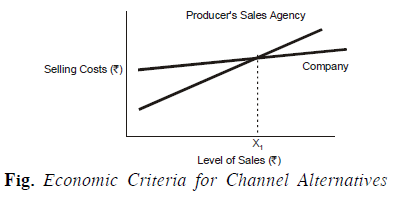
For level of sales below X1 (as shown in the figure above) provider’s sales agency will have economic advantage over their own sales force. But when the level of sales increases above the level X1, the company’s sales force will be more economical.
(ii) Control and Adaptive Criteria: The channel alternatives are evaluated in terms of companies having better
Evaluation of the Channel Alternatives:
Each channel alternative can be evaluated against the following criteria:
(i) Economic Criteria: Each alternative channel design will result in different levels of sales and cost as shown in Figure.
For level of sales below X1 (as shown in the figure above) provider’s sales agency will have economic advantage over their own sales force. But when the level of sales increases above the level X1, the company’s sales force will be more economical.
(ii) Control and Adaptive Criteria: The channel alternatives are evaluated in terms of companies having better
