
6
The companies having business in a large number of countries around the world at present are called:
PREVIOUS YEAR SOLVED PAPERS MCQ - December 2018


Banking Ombudsman is a quasi judicial
authority functioning under the Banking
Ombudsman Scheme, 2006. The authority was
created to enable resolution of complaints of
customers of banks relating to services
rendered by the lenders.
Banking Ombudsman Scheme is a mechanism created by the RBI to address the complaints raised by bank customers. It is run by the RBI directly to ensure customer protection in the banking industry. According to the RBI, “The Scheme enables an expeditious and inexpensive forum to bank customers for resolution of complaints relating to certain services rendered by banks.”
The Banking Ombudsman Scheme was introduced under Section 35 A of the Banking Regulation Act, 1949 by RBI with effect from 1995. The present Ombudsman scheme was introduced in 2006.
The Banking Ombudsman is a senior official appointed by the Reserve Bank of India. He has the responsibility to redress customer complaints against deficiency in certain banking services. At present fifteen Ombudsmen were appointed by the RBI to settle complaints and they are appointed in state capitals.
All Scheduled Commercial Banks, Regional Rural Banks and Scheduled Primary Cooperative Banks are covered under the Scheme.
The Banking Ombudsman can receive and consider any complaint relating to a number of deficiencies related to banking operations including internet banking. RBI has mentioned a large number of service deficiencies by banks to customers where the customers can approach the Ombudsman through a complaint.
Graphical method of locating the median
Median can be located with the help of a cumulative frequency curve or by an ‘ogive’ curves. From the point of intersection of ‘less than’ and ‘more than’ ogives, if a perpendicular is drawn on the X axis, the point so obtained on the horizontal axis gives the value of the median.
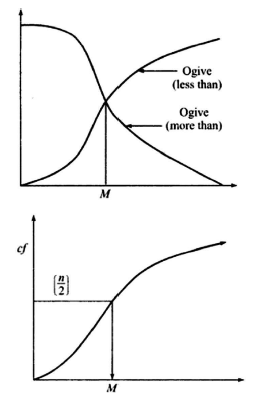
If ogive is drawn using cumulated percentage frequencies, then we draw a straight line from the point representing 50 percent cumulated frequency on the Y-axis parallel to the X-axis to intersect the ogive. A perpendicular drawn from this point of intersection on the horizontal axis gives the value of the median.
Median can be located with the help of a cumulative frequency curve or by an ‘ogive’ curves. From the point of intersection of ‘less than’ and ‘more than’ ogives, if a perpendicular is drawn on the X axis, the point so obtained on the horizontal axis gives the value of the median.
If ogive is drawn using cumulated percentage frequencies, then we draw a straight line from the point representing 50 percent cumulated frequency on the Y-axis parallel to the X-axis to intersect the ogive. A perpendicular drawn from this point of intersection on the horizontal axis gives the value of the median.
10
Match the items of List-I with the items of List-II and choose the correct answers from the code given below.
| LIST-I | LIST-II |
| (a) Job context | (i) Procedures used |
| (b) Job-related tangibles and intangibles | (ii) Work schedule |
| (c) Work activities | (iii) Work standards |
| (d) Work performance | (iv) Services rendered |
CODES
| (a) | (b) | (c) | (d) | |
| 1 | (ii) | (iv) | (i) | (iii) |
| 2 | (iv) | (iii) | (i) | (ii) |
| 3 | (iii) | (iv) | (ii) | (i) |
| 4 | (i) | (iv) | (ii) | (iii) |
Types of Information to be Collected by Job Analysis
Work Activities
∎ Job-oriented activities (description of the work activities performed, expressed in “job” terms, usually indicating what is accomplished, such as galvanising, weaving, cleaning, and so on; sometimes such activity descriptions also indicate how, why and when a worker performs an activity; usually the activities are those involving active human participation, but In certain instances they may characterise machine or system functions).
∎ Work activities/processes.
∎ Procedures used.
∎ Activity records (such as films).
∎ Personal accountability/responsibility.
Worker-Oriented Activities
∎ Human behaviours performed in work (such as sensing, decision making, performing physical actions or communicating).
∎ Elemental motions (such as those used in time and motion studies).
∎ Personal job demands (human expenditures involved in work, such as energy expenditure).
Machines, Tools, Equipment and Work Aids Used
∎ Computers (hardware and software).
∎ Safety equipment (goggles and groves).
∎ Office tools (pone, fax and books).
Job-Related Tangibles and Intangibles
∎ Materials processed.
∎ Products made.
∎ Knowledge dealt with or applied (such as law or chemistry).
∎ Services rendered (such as laundering or repairing).
Work Performance
∎ Work measurements (i.e., time taken).
∎ Work standards.
∎ Error analysis.
∎ Other aspects.
Job Context
∎ Physical working conditions.
∎ Work schedule.
∎ Organised context.
∎ Social context.
∎ Incentives (financial and non-financial).
Personal Requirements
∎ Job-related knowledge and/or skills (such as education, training, or work experience required).
∎ Personal attributes (such as aptitudes, physical characteristics, personality, interests required).
