


Here foo(1) is recursive function. Spare complexity
is O (n) as there can be at most O (n) active
function at a time
Data Structures and Algorithms MCQ - Performance Analysis of Algorithms and Recurrences
Space complexity is O (n). The space we need array
of size O (n). The space required for recursive
call would be O (1) as the value would be taken
from array again & again
If n is a power of 2, then
 term
If n is not a power of 2, then there will be minor differences of 1 at
term
If n is not a power of 2, then there will be minor differences of 1 at  wherever
  is odd.
Hence val(j) computed on the basis of n = 2n will give a fair answer
is odd.
Hence val(j) computed on the basis of n = 2n will give a fair answer
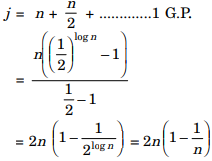 = 2(n – 1) = θ(n)
term
If n is not a power of 2, then there will be minor differences of 1 at wherever is odd.
Hence val(j) computed on the basis of n = 2n will give a fair answer
= 2(n – 1) = θ(n)
49
Consider the following recurrence
T(n) = 2T([√n]) + 1,T(1) = 1
Which one of the following is true?
T(n) = 2T(√n) + 1
Put n = 2k
T(2k) = 2T(nk/2) + 1
replace T(2k) by S(k)
S(k) = 2 S(k/2) + 1
Apply masters
Klog22 ⇒ k > 1
So Θ(k)
Now we know n = 2k, k = log2(n)
then Θ(logn)
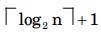

Since, j increases in power of 2's.
if statement j = j * 2 executes k times, then
2k < n
⇒ k < log2 n
Since k will be integer,
total number of comparison
 (when loop exits)
(when loop exits)