


Since d(q) = d(p) + 1 and F(q) < f(P) which means
p & q are connected and r is sperate so option (d)
is correct answer.
Data Structures and Algorithms MCQ - Graph Algorithm
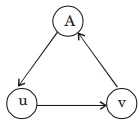 Suppose v is starting vertex so start DFS at node v
(i) visit t (v) → DFS(A) → visit (A) → DFS
(v) → visit (u) → back track (A) → Back track (v)
therefore d[v] > d[v], d[v] < f[v] f[v] < f[v]
But visiting order is just opposite of finishing order.
Hence f[v] > f[v]
Suppose v is starting vertex so start DFS at node v
(i) visit t (v) → DFS(A) → visit (A) → DFS
(v) → visit (u) → back track (A) → Back track (v)
therefore d[v] > d[v], d[v] < f[v] f[v] < f[v]
But visiting order is just opposite of finishing order.
Hence f[v] > f[v]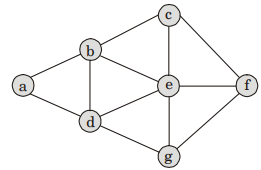
a b e f d g c, a b e f c g d, a d g e b c f are possible
dFs traverse of given graph.
DFS visits each vertex once and as it visits each
vertex, we need to find all of its neighbours to
figure out where to search next. Finding all its
neighbour s in an adjacency matrix r equires
O(V) time, so overall the running time will be
O(V2).
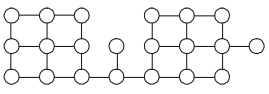
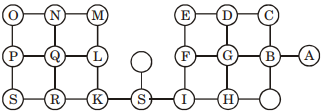 Maximum DFS recurside depth is 19
A → B → C → D → E → F → G → H → I → J → K
→ L → M → N → O → P → Q → R → S
Maximum DFS recurside depth is 19
A → B → C → D → E → F → G → H → I → J → K
→ L → M → N → O → P → Q → R → S