


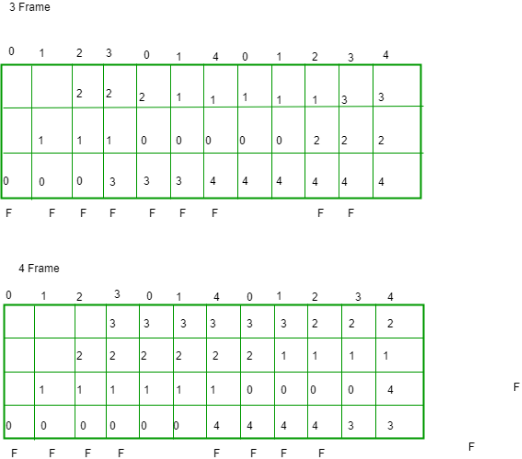
 There are 9 page fault in 3 frame FIFO relacement policy and 10 page fault in 3 frame FIFO relacement policy. So, option (D) is correct.
PREVIOUS YEAR SOLVED PAPERS MCQ - JULY 2016 Paper 2
There are 9 page fault in 3 frame FIFO relacement policy and 10 page fault in 3 frame FIFO relacement policy. So, option (D) is correct.
37
Suppose there are four processes in execution with 12 instances of a Resource R in a system. The maximum need of each process and current allocation are given below : With reference to current allocation, is system safe ? If so, what is the safe sequence ?
| Process | Max.need | Allocation |
| P1 | 8 | 3 |
| P2 | 9 | 4 |
| P3 | 5 | 2 |
| P4 | 3 | 1 |
Current allocation of P1P2P3P4 are 3, 4, 2, 1 which is 10 in total. We have 12 total no of resources and out of them 10 are allocated so, we have only 2 resources. There is 5, 5, 3, 2 resources are needed for P1P2P3P4 respectively. So, P4 will run first and free 3 resources after execution. Which are sufficient for P3 So it will execute and do free 5 resources. Now P1 and P2 both require 5 resources each So we can execute any of them first but we will give priority to P1. The execution order will be P4P3P1P2. SO, option (C) is correct.
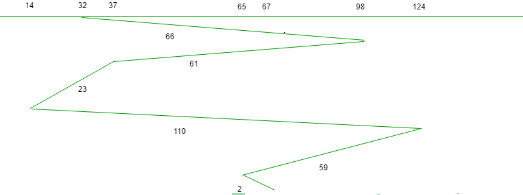 Total disk movement = 66 + 61 + 23 + 110 + 2 = 321. So, option (C) is correct.
In UNIX, mkdir PIS PIS/progs PIS/data creates three subdirectories: ‘PIS’ and two subdirectories ‘progs’ and ‘data’ from just created subdirectory ‘PIS’. So, option (C) is correct.
A scheduling Algorithm assigns priority proportional to the waiting time of a process. Every process starts with priority zero (lowest priority). The scheduler reevaluates the process priority for every ‘T’ time units and decides next process to be scheduled. If the process have no I/O operations and all arrive at time zero, then the scheduler implements Round Robin Scheduling criteria. So, option (B) is correct.
