PREVIOUS YEAR SOLVED PAPERS MCQ - December 2015 Paper 2

Correct AnswerOption B
Rate difficulty Rate difficulty:
Choose a difficulty.

We must choose at least 3 women, so we calculate the case of 3 women, 4 women and 5 women and by addition rule add the result.

12C3 x 20C2 +12C4 x 20C1 + 12C5 x 20C0 = (12x11x10/3x2x1) x (20x19/2x1) + (12x11x10x9/4x3x2x1) x 20 + (12x11x10x9x8/5x4x3x2x1) x 1

= 220 x 190 + 495 x 20 + 792

= 52492
Cancel reply

Your email address will not be published. Required fields are marked *


Cancel reply

Your email address will not be published. Required fields are marked *

Correct AnswerOption D
Rate difficulty Rate difficulty:
Choose a difficulty.

EulerCircuits: An Euler circuit is a circuit that uses every edge of a graph exactly once.
HamiltonCircuit: Hamilton circuit, is a graph cycle (i.e., closed-loop) through a graph that visits each node exactly once
Bipartite Graph: A bipartite graph, also called a bigraph, is a set of graph vertices decomposed into two disjoint sets such that no two graph vertices within the same set are adjacent. A bipartite graph is a special case of a k-partite graph with k=2.
From the above definitions, we can see that (d) is false. So the answer is (D).
Cancel reply

Your email address will not be published. Required fields are marked *


Cancel reply

Your email address will not be published. Required fields are marked *

Correct AnswerOption D
Rate difficulty Rate difficulty:
Choose a difficulty.
  • The set of negative integers is countable.
  • The set of integers that are multiples of 7 is countable.
  • The set of even integers is countable.
  • The set of real numbers between 0 and ½ is countable.This is not true because we can not count set of real numbers.
So, Option (D) is correct.
Cancel reply

Your email address will not be published. Required fields are marked *


Cancel reply

Your email address will not be published. Required fields are marked *

Correct AnswerOption C
Rate difficulty Rate difficulty:
Choose a difficulty.
Found this useful?
Follow:

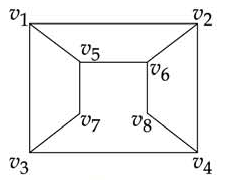
A simple graph G=(V,E) is called bipartite if its vertex set can be partitioned into two disjoint subsets V=V1⋃V2, such that every edge has the form e=(a,b) where aϵV1 and bϵV2.
Bipartite graphs are equivalent to two-colorable graphs.
1. Assign Red color to the source vertex (putting into set V1).
2. Color all the neighbours with Black color (putting into set V2).
3. Color all neighbour’s neighbour with Red color (putting into set V1).
4. This way, assign color to all vertices such that it satisfies all the constraints of m way coloring problem where m = 2.
5. While assigning colors, if we find a neighbour which is colored with same color as current vertex, then the graph cannot be colored with 2 colors (ie., graph is not Bipartite).
So answer is option (C).
Cancel reply

Your email address will not be published. Required fields are marked *


Cancel reply

Your email address will not be published. Required fields are marked *

Correct AnswerOption D
Rate difficulty Rate difficulty:
Choose a difficulty.

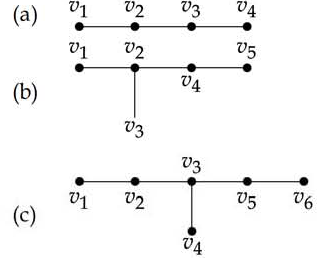
Caterpillar tree: In graph theory, a caterpillar is a tree in which all the vertices are within distance 1 of a central path.
Theorem: All caterpillars are graceful.
So, (a), (b) and (c) are graceful.
Cancel reply

Your email address will not be published. Required fields are marked *


Cancel reply

Your email address will not be published. Required fields are marked *

Why Practice with Avatto?
High Quality MCQsExam-focused questions with accurate answers
Detailed ExplanationsStep-by-step explanations to enhance learning
Latest Exam PatternBased on updated syllabus and pattern
Performance AnalyticsTrack performance and improve weak areas
100% Free PracticePractice unlimited questions for free
Boost Your PreparationAttempt mock tests, previous year papers and topic-wise quizzes.Explore All Tests →