


To solve this question we will apply traditional approach:
(326.4)8 = 82 * 3 + 81 * 2 + 80 * 6 . 8-1 * 4 = ( 214.5)10 is decimal representation.
For hexadecimal representation group binary sequence of (214.5) = (011010110.100)2 into group of 4.
i.e. 0 1101 0110. 1000 (0 can be padded after decimal) this is equivalent to- (D6.8)16.
So, option (C) is correct.
PREVIOUS YEAR SOLVED PAPERS MCQ - August 2016 Paper 2
Sign's magnitude is only for sign convention (MSB is 1 then no is negative and if 0 then no is positive).
Main difference is that while adding numbers using 1′ s complement, we first do binary addition, then add in an end-around carry value.
But, 2′ s complement has only one value for zero, and doesn’t require carry values.
9’s complement of a decimal number is the subtraction of it’s each digits from 9.
Like 1’s complement, 9’s complement is used to subtract a number using addition.
2's complement representation is unambiguous for 0 (i.e., only positive 0), but Sign-magnitude, 1’s complement and 9’s complement are ambiguous representation for 0 (i.e., both positive and negative 0).
So, option (C) is correct.
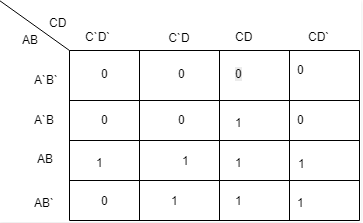
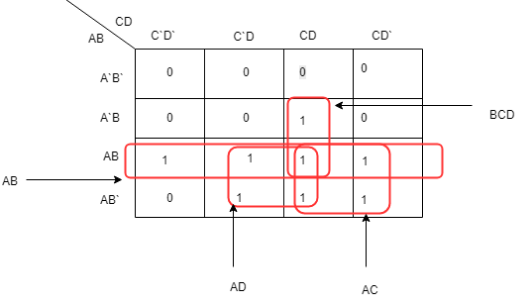 By grouping we will simply get AB + AC + AD + BCD. So, option (B) is correct.
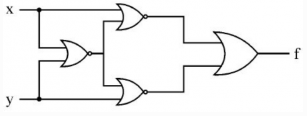

10
Match the following:
| List I | List II |
| a. Controlled Inverter | i. a circuit that can add 3 bits |
| b. Full adder | ii. a circuit that can add two binary numbers |
| c. Half adder | iii. a circuit that transmits a binary word or its 1's complement |
| d. Binary adder | iv. a logic circuit that adds 2 bits |
Codes:
| a | b | c | d | |
| (1) | iii | ii | iv | i |
| (2) | ii | iv | i | iii |
| (3) | iii | iv | i | ii |
| (4) | iii | i | iv | ii |
Controlled Inverter is a circuit that transmits a binary word or its 1’s complement. Full adder is a circuit that can add 3 bits. Half adder is a logic circuit that adds 2 bits. Binary adder is a circuit that can add two binary numbers. So, option (D) is correct.
