Case I:
S and R are criminal in the result is impossible because only one person committed the crime.
Case II:
Q and R are criminal in the result is impossible because only one person committed the crime. Case III:
SNC and SC in the result which is contradiction. [S committed crime and same time not committed crime which is contradiction]
Case IV:
R is criminal in the result.
Hence this case satisfies only one person committed the crime.
| Criminals | P | Q | R | S |
| Assumption | F | T | F | F |
| Result | QNC | SC | RC | SC |
| Criminals | P | Q | R | S |
| Assumption | T | F | F | F |
| Result | QC | SNC | RC | SC |
| Criminals | P | Q | R | S |
| Assumption | F | F | T | F |
| Result | QNC | SNC | RNC | SC |
| Criminals | P | Q | R | S |
| Assumption | F | F | F | T |
| Result | QNC | SNC | RC | SNC |
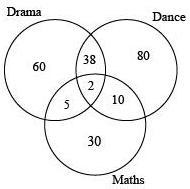 Total number of students = 60 + 80 + 30 + 38 + 5 + 10 + 2 = 225
25% = 225
100% = (225/25) x 100 = 900