PREVIOUS YEAR SOLVED PAPERS MCQ - GATE 2018

Correct AnswerOption C
Rate difficulty Rate difficulty:
Choose a difficulty.
Share this question
Share:

F(P, Q, R, S) = Σm(0, 2, 5, 7, 9, 11) + d(3, 8, 10, 12, 14)
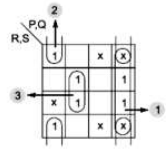
Number of EPI = 3
Cancel reply

Your email address will not be published. Required fields are marked *


Cancel reply

Your email address will not be published. Required fields are marked *

Correct AnswerOption A
Rate difficulty Rate difficulty:
Choose a difficulty.

Given, total number of instructions (n) = 100
Number of stages (k) = 5
Since, if n instructions take c cycle, so (c-1) stalls will occur for these instructions.
Therefore, the number of clock cycles required = Total number of cycles required in general case + Extra cycles required (here, in PO stage)
= (n + k – 1) + Extra cycles
= (100 + 5 -1) + 40*(3-1)+35*(2-1)+20*(1-1)
= (100 + 4) + 40*2+35*1+20*0
= 104 + 115
= 219 cycles
Cancel reply

Your email address will not be published. Required fields are marked *


Cancel reply

Your email address will not be published. Required fields are marked *

Correct AnswerOption B
Rate difficulty Rate difficulty:
Choose a difficulty.

The graph has 100! Vertices which each vertex labeled by one of the 100! Permutation.
take a vertex whose labeling is say 1,2,3,4, …..,100.
Now it will be connected to all vertices where exactly 2 of the adjacent numbers all swapped.
The two swapped numbers could be (1, 2), (2, 3), (3, 4) …. etc. upto (99, 100) which makes for 99 edges for each such vertex.
So the graph is a regular graph with each vertex connected to 99 other vertices.
So y = 99
The number of connected components = z = 1 since we can go from any vertex to any other vertex by only swapping 2 adjacent number at a time, many times i.e. there is a path from any vertex to any other vertex.
Graph is connected.
So z = 1
So y + 10z = 99 + 10 x 1 = 109
Cancel reply

Your email address will not be published. Required fields are marked *


Cancel reply

Your email address will not be published. Required fields are marked *

Correct AnswerOption A
Rate difficulty Rate difficulty:
Choose a difficulty.

We need to find smallest value of k which satisfies
L1k = L1k+1

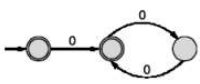
L1 = ε + (00)
Try k = 0; L10 = L11
ε = L1 which is false.
So order is not 0.
Try k = 1: L11 = L12
L12 = L1 Now, L12 =(ε + 0(00)*)(ε + 0(00)*)
= ε + 0(00)* + 00(00)* = 0*
Clearly L12 ≠ L1
So order is not 1.
Try k = 2: L12 = L13
Now, L13 = L12.L1
= 0*(ε + 0(00)*) = 0*
Clearly L13 = L12=0*
(so, order of L1 is 2)
Cancel reply

Your email address will not be published. Required fields are marked *


Cancel reply

Your email address will not be published. Required fields are marked *

Correct AnswerOption A
Rate difficulty Rate difficulty:
Choose a difficulty.
Found this useful?
Follow:

T(N) =(N-1)Ck * T(k) * T(N-k-1), where k = number of nodes on left subtree
T(1) = 1
T(2) = 1
T(3) = 2
T(4) = 3C2 * T(2) * T(1) = 3
T(5) = 4C3 * T(3) * T(1) = 8
T(6) = 5C3 * T(3) * T(2) = 20
T(7) = 5C3 * T(3) * T(3) = 80
Cancel reply

Your email address will not be published. Required fields are marked *


Cancel reply

Your email address will not be published. Required fields are marked *

Why Practice with Avatto?
High Quality MCQsExam-focused questions with accurate answers
Detailed ExplanationsStep-by-step explanations to enhance learning
Latest Exam PatternBased on updated syllabus and pattern
Performance AnalyticsTrack performance and improve weak areas
100% Free PracticePractice unlimited questions for free
Boost Your PreparationAttempt mock tests, previous year papers and topic-wise quizzes.Explore All Tests →