Computer Organization And Architecture MCQ - Memory Hierarchy

Correct AnswerOption A
Rate difficulty Rate difficulty:
Choose a difficulty.
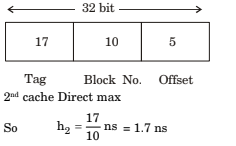
Here, we have 32 bit virtual address space.
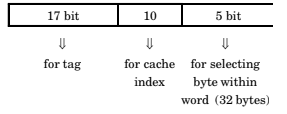
32 kB cache memory hence, we need 15 bit for occuring them (not all for indexing explained next). So 17 used for tag.
But here cache are in block of 32 bytes. So, there actually 1 K (blocks) for a indexing 1 K location, we need 10 bits.
Remainder five are used for selecting byte
memory-hierarchy
Cancel reply

Your email address will not be published. Required fields are marked *


Cancel reply

Your email address will not be published. Required fields are marked *

Correct AnswerOption A
Rate difficulty Rate difficulty:
Choose a difficulty.
1. I-cache
Number of blocks in cache = 4K/4 = 210 blocks.
Bits to represent blocks = 10
Number of words in a block = 4 = 22 words.
Bits to represent words = 2.
tag bits = 30 – (10 + 2) = 18.
Each block will have it's own tag bits.
So total tag bits =1K * 18 bits.
2. D-cache
Number of blocks in cache = 4K/4 = 210 blocks.
Number of sets in cache = 210/2 = 29 sets.
Bits to represent sets = 9.
Number of words in a block = 4 = 22 words.
Bits to represent words = 2
tag bits = 30 – (9 + 2) = 19
Each block will have it's own tag bits.
So total tag bits = 1K * 19 bits.
3. L2 cache
Number of blocks in cache = 64K/16 = 212 blocks.
Number of sets in cache = 212/4 = 1024 sets.
Bits to represent sets = 10
Number of words in cache = 16 = 24 words.
Bits to represent words = 4.
tag bits = 30 – (10 + 4) = 16
Each block will have it's own tag bits.
So total tag bits = 212 * 16-bits = 4K * 16-bits.
Cancel reply

Your email address will not be published. Required fields are marked *


Cancel reply

Your email address will not be published. Required fields are marked *

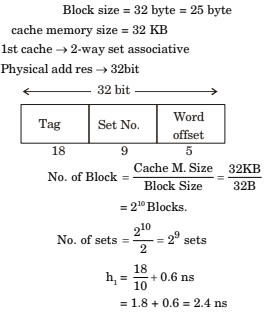
Consider two cache organizations : The first one is 32 KB 2-way set associative with 32-byte block size. The second one is of the same size but direct mapped. The size of an address is 32 bits in both cases. A 2-to-1 multiplexer has latency of 0.6 ns while a k-bit comparator has a latency of k/10 ns. The hit latency of the set associative organization is h1 while that of the direct mapped one is h2
Correct AnswerOption A
Rate difficulty Rate difficulty:
Choose a difficulty.
memory-hierarchy
Cancel reply

Your email address will not be published. Required fields are marked *


Cancel reply

Your email address will not be published. Required fields are marked *

Consider two cache organizations : The first one is 32 KB 2-way set associative with 32-byte block size. The second one is of the same size but direct mapped. The size of an address is 32 bits in both cases. A 2-to-1 multiplexer has latency of 0.6 ns while a k-bit comparator has a latency of k/10 ns. The hit latency of the set associative organization is h1 while that of the direct mapped one is h2
Correct AnswerOption D
Rate difficulty Rate difficulty:
Choose a difficulty.
Found this useful?
Follow:
memory-hierarchy
Cancel reply

Your email address will not be published. Required fields are marked *


Cancel reply

Your email address will not be published. Required fields are marked *

Correct AnswerOption B
Rate difficulty Rate difficulty:
Choose a difficulty.
For identifying each of 128 lines uniquely, number of bits required = 7 bits.
Since each line is of size 64 words, so number of bits needed to identify each word uniquely = 6 bits. Now, since there are 20 bits in address generated by CPU
 Bits needed for tag = 20 – (7 + 6) = 7 bits.
Cancel reply

Your email address will not be published. Required fields are marked *


Cancel reply

Your email address will not be published. Required fields are marked *

Why Practice with Avatto?
High Quality MCQsExam-focused questions with accurate answers
Detailed ExplanationsStep-by-step explanations to enhance learning
Latest Exam PatternBased on updated syllabus and pattern
Performance AnalyticsTrack performance and improve weak areas
100% Free PracticePractice unlimited questions for free
Boost Your PreparationAttempt mock tests, previous year papers and topic-wise quizzes.Explore All Tests →