Quantitative Aptitude - Numbers and Algebra

Avatto > > Bank Exam > > Practice Questions > > Quantitative Aptitude > > Numbers and Algebra

41. Which of the following is true?

  • Option : D
  • Explanation : (√2+√5)² = 2 + 2√10 +5 =7+2√10
    (√7)² = 7
    ∴ √2+√5> 7
    Alternatively:
    √2 > √1 and √5 > √4
    ∴ √2+√5 > 2+1 
    => √2 + √5 > 3 and √7 < √9 = 3
    => √7 < 3. 
    so √2 + √5>√7
Cancel reply

Your email address will not be published. Required fields are marked *


Cancel reply

Your email address will not be published. Required fields are marked *


42. If a, b, c, d, p and q are non-zero, unequal integers  and (a+bi)/(c+di) equals

  • Option : B
  • Explanation : a + bi p c + di q qa + qbi = pc + pdi Equating real and imaginary parts. qa = pc and qb = pd. a = -P/q -c and b = (p/q)d * a²+b² (p²/q²)c + (p²/q²)d² p² ---- = ------------------- = -- c²+d² c²+d² q²
Cancel reply

Your email address will not be published. Required fields are marked *


Cancel reply

Your email address will not be published. Required fields are marked *


43. Which of the following statements is/are true?
I.  Average of a set of values will always lie between lowest and the largest of these values.
II. If each of the values in a set is increased by a constant k, then new average of the set is increased by k.
III. If each of the values in a set is multiplied by a constant m, then new average will also be `m' times the old average
Codes

  • Option : D
  • Explanation : I. Average of a set of numbers is greater than smallest and smaller than the greatest number of the set. Thus, I is true.

    II. Consider five numbers a, b, c, d and e whose average is (a+b+c+d+e) / 5 Now if each of them is increased by k, then we have average =a+k+b+k+c+k+d+k+e+k 5 =a+b+c+d+e + 5k = old average +k. 5 5 Thus, II is true

    III. Consider three numbers x,y and z whise average is (x+y+z) /3 Now each of them is multiplies by m then new average =(xm +ym+zm) / 3 = m((x+y+x)/3) = 3x odd average Thus III is true.

Cancel reply

Your email address will not be published. Required fields are marked *


Cancel reply

Your email address will not be published. Required fields are marked *


44. What is the least number which on being divided by 5, 6, 8, 9, 12 leaves in each case a remainder 1 but when divided by 13 leaves no remainder?

  • Option : B
  • Explanation :

    L.C.M. of 5, 6, 8, 9 and 12 is 360
    Required number = 360 K + 1 = (13 x 27 + 9) K + 1
    = (13 x 27) K + (9K + 1)
    Now this number must be divisible by 13 K = 10 and required number = 3601.
Cancel reply

Your email address will not be published. Required fields are marked *


Cancel reply

Your email address will not be published. Required fields are marked *


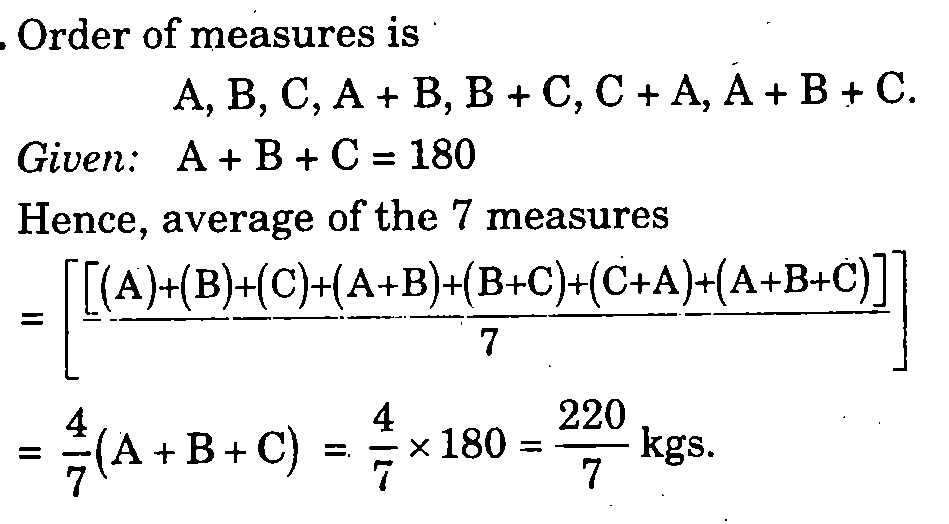
45. Three people A, B and C weigh themselves in a particular order. First A, B, C weigh themselves individually and then AB, BC CA and ABC together respectively. Recorded weight for the last measured is 180 kgs. Then average of the 7 measures is

Cancel reply

Your email address will not be published. Required fields are marked *


Cancel reply

Your email address will not be published. Required fields are marked *


Related Quiz.
Numbers and Algebra