
Artificial Intelligence - Knowledge Representation
(p N (applicant ^name <n> ^salary <35000 ^status NIL) → (modify 1 ^status No) ) (p LC1 (applicant ^name <n> ^salary >100000 ^status NIL) (stocks ^holder <n> ^worth >20000) → (modify 1 ^status C1) ) (p LC2 (applicant ^name <n> ^salary >85000 ^status NIL) (stocks ^holder <n> ^worth >50000) (credit ^user <n> ^score >150) → (modify 1 ^status C2) ) Consider the following set of working memory elements: 1. (applicant ^name a ^salary 5000 ^status NIL) 2. (applicant ^name b ^salary 1035000 ^status NIL) 3. (applicant ^name c ^salary 95000 ^status NIL) 4. (credit ^user b ^score 100) 5. (credit ^user c ^score 155) 6. (stocks ^holder a ^worth 10000) 7. (stocks ^holder c ^worth 60000) 8. (stocks ^holder b ^worth 25000)


(p N (applicant ^name <n> ^salary <35000 ^status NIL) → (modify 1 ^status No) ) (p LC1 (applicant ^name <n> ^salary >100000 ^status NIL) (stocks ^holder <n> ^worth >20000) → (modify 1 ^status C1) ) (p LC2 (applicant ^name <n> ^salary >85000 ^status NIL) (stocks ^holder <n> ^worth >50000) (credit ^user <n> ^score >150) → (modify 1 ^status C2) ) Consider the following set of working memory elements: 1. (applicant ^name a ^salary 5000 ^status NIL) 2. (applicant ^name b ^salary 1035000 ^status NIL) 3. (applicant ^name c ^salary 95000 ^status NIL) 4. (credit ^user b ^score 100) 5. (credit ^user c ^score 155) 6. (stocks ^holder a ^worth 10000) 7. (stocks ^holder c ^worth 60000) 8. (stocks ^holder b ^worth 25000)
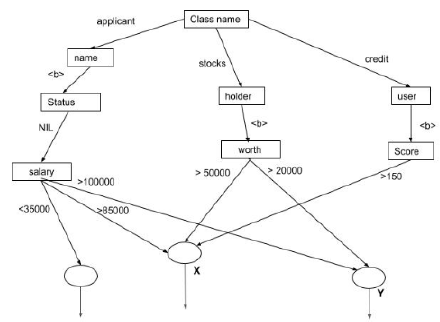 I. Rule N
II. Rule LC1
III. Rule LC2
I. Rule N
II. Rule LC1
III. Rule LC2(p N (applicant ^name <n> ^salary <35000 ^status NIL) → (modify 1 ^status No) ) (p LC1 (applicant ^name <n> ^salary >100000 ^status NIL) (stocks ^holder <n> ^worth >20000) → (modify 1 ^status C1) ) (p LC2 (applicant ^name <n> ^salary >85000 ^status NIL) (stocks ^holder <n> ^worth >50000) (credit ^user <n> ^score >150) → (modify 1 ^status C2) ) Consider the following set of working memory elements: 1. (applicant ^name a ^salary 5000 ^status NIL) 2. (applicant ^name b ^salary 1035000 ^status NIL) 3. (applicant ^name c ^salary 95000 ^status NIL) 4. (credit ^user b ^score 100) 5. (credit ^user c ^score 155) 6. (stocks ^holder a ^worth 10000) 7. (stocks ^holder c ^worth 60000) 8. (stocks ^holder b ^worth 25000)
