
Manag., July-2018 – Q46


- Option : B
- Explanation : Properties of Correlation Coefficient: The following are the important properties of the coefficient of correlation:
1. The coefficient of correlation r lies between –1 and +1, i.e., –1 £ r £ 1, i.e., a number between –1 and 1 both inclusive that describes the linear relationship between pairs of quantitative variables.
2. The correlation coefficient is independent of the change of origin and scale.
3. The correlation coefficient is the ratio of two quantities having same units, thus it is a pure number having no units.
4. The value of r does not change if all the values of either variable are converted to a different scale. For example, if the units of X are changed from feet to meters, the value of r does not change.
5. The value of r is not affected by the choice of X or Y. Interchange of all X and Y values will not change the value of r, i.e., the correlation coefficient between X and Y is equal to the correlation coefficient between Y and X.
6. r measures the strength of linear relationship. It is not designated to measure the strength of a relationship that is not linear.
7. If the sign of all the values of one of the variables is changed, the sign of the correlation coefficient changes, i.e., the correlation between X and Y is opposite in sign to the correlation between –X and Y or X and –Y.
8. If each value of X and (or) Y a constant amount is added or subtracted, the correlation coefficient remains unchanged, i.e., the correlation coefficient is independent of the change of origin.
9. If each value of X and (or) Y is multiplied or divided by a constant, the correlation coefficient remains unchanged, i.e., the correlation coefficient is independent of the change of scale.
Notes:
1. The change of origin means adding or subtracting a constant amount from given observations of the variables X and Y and the change of scale means multiplying or dividing the values of X and Y by some constant amount. The constant amount can be chosen arbitrarily as per convenience. It may be same or different for X and Y.
2. Property II is very useful for reducing computational work involved in the calculation of the coefficient of correlation and forms the basis for short-cut method.
Probable Error and Standard Error of Coefficient of Correlation
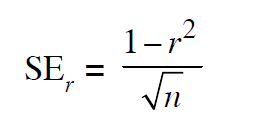
The probable error (PE) of the coefficient of correlation indicates the extent to which its value depends on the condition of random sampling. If r is the calculated value of correlation coefficient in a sample of n pairs of observations, then the standard error SEr of the correlation coefficient r is given by
The probable error of the coefficient of correlation is calculated by the expression:
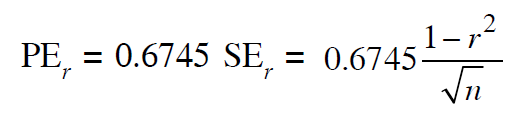
Thus with the help of PEr we can determine the range within which population coefficient of correlation is expected to fall using following formula:
p = r ± PEr
where p(rho) represents population coefficient of correlation.
Remarks
1. If r < PEr then the value of r is not significant, that is, there is no relationship between two variables of interest.
2. If r > 6PEr then value of r is significant, that is, there exists a relationship between two variables.

Accessibility
Oversized Widget
Saved in this browser. Nothing changes for anyone else.