Programming and Data Structures MCQ - Trees
Correct AnswerOption A
Rate difficulty Rate difficulty:
Choose a difficulty.
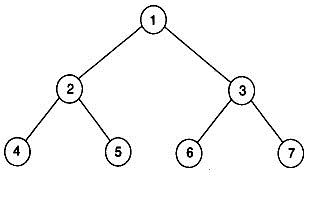
Post-order traversal yields 4, 5, 2, 6, 7, 3, 1. Comparing with a, b, -, c, d, *, +, we get the labels of nodes 1, 2, 3, 4, 5, 6, 7 ans +, -, *, a, b, c, d respectively.
Cancel reply

Your email address will not be published. Required fields are marked *


Cancel reply

Your email address will not be published. Required fields are marked *

Correct AnswerOption D
Rate difficulty Rate difficulty:
Choose a difficulty.
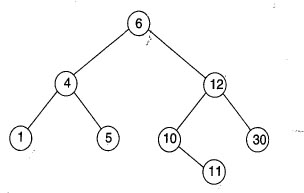
If it is to be used for sorting label of left child should be less than the label of the current node. Coming down the tree we get left child of node labeled 10 as the correct slot for 8.
Cancel reply

Your email address will not be published. Required fields are marked *


Cancel reply

Your email address will not be published. Required fields are marked *

Correct AnswerOption B
Rate difficulty Rate difficulty:
Choose a difficulty.
Found this useful?
Follow:
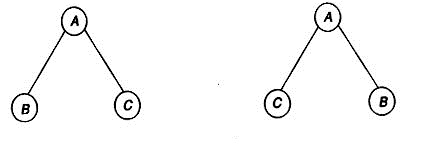
It is 12. The tree may be of depth 2 or 1. if the depth is 2, we have 6 possible trees. This is because one of the three nodes A, B, C may be the root and the next level may be one of the remaining two nodes. If the depth is 1, the root may be one of the 3 nodes A, B, C. Corresponding to a root, say A, two trees as possible as this.
Cancel reply

Your email address will not be published. Required fields are marked *


Cancel reply

Your email address will not be published. Required fields are marked *

Correct AnswerOption B
Rate difficulty Rate difficulty:
Choose a difficulty.
A strictly binary tree with 'n' leaves must have (2n-1) nodes. Verify for some small 'n'. This can be proved by the principle of mathematical induction.
explanationq132
Cancel reply

Your email address will not be published. Required fields are marked *


Cancel reply

Your email address will not be published. Required fields are marked *

Correct AnswerOption A
Rate difficulty Rate difficulty:
Choose a difficulty.
If the depth is d, the number of nodes n will be 2 (d+1)-1
So, n+1 = 2(d+1) or d = log (n+1)-1
Cancel reply

Your email address will not be published. Required fields are marked *


Cancel reply

Your email address will not be published. Required fields are marked *

Why Practice with Avatto?
High Quality MCQsExam-focused questions with accurate answers
Detailed ExplanationsStep-by-step explanations to enhance learning
Latest Exam PatternBased on updated syllabus and pattern
Performance AnalyticsTrack performance and improve weak areas
100% Free PracticePractice unlimited questions for free