


1. We can use “Depth First Search” Algorithm,
to check it there is a cycle is an undirected
graph. I t we encounter any “back edge” in
“Depth first search” then given undirected
graph has a cycle. Also, If there is a cycle in
the Undirected graph, we must encounter a
“back edge” in DFS. And, DFS can be done in
O(| E| + | V| ) time for graph G = (V, E). So, it
can is in F.
2. P ≤ NP, So, it is also in NP.
3. NP - complete problem A ∈ NP. By, Definition
Every problem in NP can be solved in
polynomial time using non-deterministic
turing machine.
So, Answer is (A) i.e. 1, 2, and 3 are true.
Algorithms MCQ - Algorithm Design Techniques

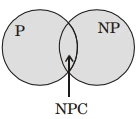
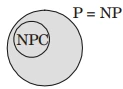
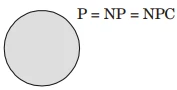
The most important open question in complexity
t heor y is whether the P = NP, which asks
whether polynomial time algorithms actually exist
for NP-complete and all NP problems (since a
problem “C” is in NP-complete, iff C is in NP and
every problem in NP is reducible to C in
polynomial time). In the given question it is given
that some polynomial time algorithm exists which
computes the largest clique problem in the given
graph which is known NP-complete problem.
Hence P = NP = NP-Complete.
2CNF SAT can be solvable in polynomial time by
reduction to directed graph reach ability.
