
Manag., December-2019 – Q83
0. Customer Life Time Value (CLV) in the first year is


- Option : A
- Explanation : Customer Lifetime Value (CLV): When customers purchase products/services, the firm earns revenues; it also accrues costs. If sales revenues are greater than costs, the firm earns profits. The profit earned from an individual customer during a single time period (year) is the profit margin—the annual value the customer brings to the firm. Of course, many customers—consumers (B2C), partners, distributors, and resellers (B2B)—purchase the firm’s products for several successive years. Each year, the firm receives sales revenues, accrues costs, and earns a profit margin. CLV takes into account profit margins the firm earns in each of these years.
Some firm customers this year will not be customers next year. They may defect to competitors, or stop buying the types of products the firm offers. In calculating CLV, we must consider customer defection and customer retention. Retention rate is simply the number of retained customers at the end of the year, divided by the number of customers at the start of the year. If the firm starts the year with 100 customers and ends the year with 80 of these same customers, the retention rate is 80 percent. Retention is the inverse of defection (churn ). In this illustration, the defection rate is 20 percent (100 percent minus 80 percent). Understanding CLV allows the firm to better manage its customer base.
Calculating CLV: In each year, the firm earns a portion of its CLV. In the first year, it earns
CLV (1):
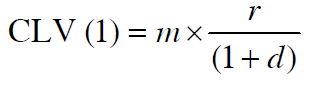
CLV (1) = m × r/(1 + d)
Restating this simple expression in words, CLV (1) is:
> The profit margin (m) the firm earns in year 1.
> Multiplied by the retention rate (r)—the probability that a customer at the start of the year will still be a customer at the end of the year.
> Discounted back to the start of the year, using the term 1/(1 + d). The discount rate (d) is the firm’s cost of capital– typically provided by the Chief Financial Officer ( CFO).
