info@avatto.com
+91-9920808017
6. If A, B, C are three events, then P(A ∩ B ∪ C) =
P(A) + P(B) + P(C) - P(A ∩ B) - P(A ∩ C)
P(A) + P(B) + P(C) - P(B)P(C)
P(A ∩ B) + P(A ∩ C) - P(A ∩ B ∩ C)
P(B ∩ C) + P(A ∩ B) - P(A ∩ B ∩ C)
Your email address will not be published. Required fields are marked *
Report
Name
Email
Website
Save my name, email, and website in this browser for the next time I comment.
Comment
7. If A and B are two arbitrary events, then P(A ∩ B) cannot be
less than P(A) + P(B) - 1
greater than P(A) + P(B)
equal to P(A) + P(B) - P(A ∪ B)
equal to P(A) + P(B) + P(A ∪ B)
8. If M and N are two events, then probability that exactly one of them occurs is not equal to
P(M) + P(N) - 2P(M ∩ N)
P(M) + P(N) - P(M ∩ N)
P(M') + P(N') - 2P(M' ∩ N')
P(M ∩ N') + P(M' ∩ N)
9. If A and B are any two events then which one of the following pairs of events,are mutually exclusive?
A ∪ B and A ∩ B'
A ∪ B and A' ∩ B
A ∪ B and A' ∩ B'
A ∪ B and A ∩ B
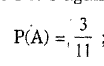
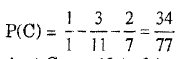
10. There are three events A, B, C one of which must, and only one can happen, the odds are 8 to 3 against A, 5 to 2 against B. The odds against C are
43 to 34
32 to 23
34 to 13
none of these
and P(A) + P(B) + P(C) = 1
Hence odds against C are 43 to 34.
Login with Facebook
Login with Google
Forgot your password?
Lost your password? Please enter your email address. You will receive mail with link to set new password.
Back to login