
PREVIOUS YEAR SOLVED PAPERS - GATE 2017 Shift 1


- Option : A
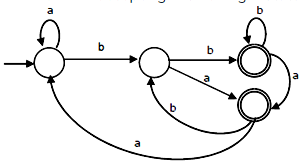
- Explanation : The regular expression can be described as “All strings over {a, b} ending with “ba” or “bb”. The minimal DFA accepting L is having 4 states:
- Option : A
- Explanation : Number of memory access in 1000 instructions = 1.4 x 1000 = 1,400 ∴ Miss rate = 7/(1400 x 0.1) = 0.05
| Process | Arrival time | Burst time |
| P1 | 0 | 7 |
| P2 | 3 | 3 |
| P3 | 5 | 5 |
| P4 | 6 | 2 |
If the pre-emptive shortest remaining time first scheduling algorithm is used to schedule the processes, then the average waiting time across all processes is _______ milliseconds.
Note: Numerical Type question.
- Option : C
- Explanation :
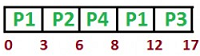 Turn Around Time
P1 = 12-0 = 12
P2 = 6-3 = 3
P3 = 17-5 = 12
P4 = 8 - 6 = 2
Waiting Time
P1 = 12-7 = 5
P2 = 3-3 = 0
P3 = 12-5 = 7
P4 = 2 - 2 = 0
Average Waiting time = (7+0+5+0)/4 = 3.0
Therefore, option C is correct
Turn Around Time
P1 = 12-0 = 12
P2 = 6-3 = 3
P3 = 17-5 = 12
P4 = 8 - 6 = 2
Waiting Time
P1 = 12-7 = 5
P2 = 3-3 = 0
P3 = 12-5 = 7
P4 = 2 - 2 = 0
Average Waiting time = (7+0+5+0)/4 = 3.0
Therefore, option C is correct
| EMP | ||
| EmpId | Emp Name | Dept Name |
| 1. | XYA | AA |
| 2. | XYB | AA |
| 3. | XYC | AA |
| 4. | XYD | AA |
| 5. | XYE | AB |
| 6. | XYF | AB |
| 7. | XYG | AB |
| 8. | XYH | AC |
| 9. | XYI | AC |
| 10. | XYJ | AC |
| 11. | XYK | AD |
| 12. | XYL | AD |
| 13. | XYM | AE |
| SELECT AVG (EC.Num)FROM ECWHERE(DeptName, Num)IN (SELECT DeptName, COUNT(EmpId)AS EC(DeptName,Num) FROMEMP GROUP BY DeptName) |
The output of executing the SQL query is _____.
Note – Numerical Type question
- Option : C
- Explanation : Given, v= Total vertices = 10 e = v – 1 =9 Degree = 2 * e = 18 Therefore, option C is correct
